

Post-Sindoor: Pakistan's One Year Inventory
A year after the may 2025 clashes and Operation Sindoor, where does Pakistan find itself today? A Pakistan Paigham x Grammar of War collaboration


A year after the clashes between India and Pakistan, both countries will tell you they emerged as the victor. In some ways, the year that followed has been beneficial for Pakistan; in others, not so much. The picture that exists today is complex. Military spending is up, and defence exports are up too. On the other hand, Pakistan’s reliance on China remains integral to its security calculus, and the economy continues to be sustained by IMF tranches. Asim Munir remains at the forefront of Pakistani politics, and the military is as involved in political decision-making as it has ever been. Pakistan has also brokered its position as the negotiator for a potential deal to end one of the most impactful wars of the 21st century. What follows is a stock-take of where Pakistan finds itself 12 months after one of the most significant Indo-Pak confrontations in decades.
The conflict made the case for everyone who has called for an increase in Pakistan’s defence budget. In some sense, these wishes were realised– the 2025-26 budget allotted PKR 3.2 trillion to defence spending (approximately $11.6 billion). Despite the fact that overall government expenditure decreased by about 7%, defence spending saw an increase of about 20%. An Armed Forces Development Programme, believed to augment military procurement, received PKR 300 billion. Pakistan’s state-run defence industrial enterprises were also allocated PKR 1.7 billion. While a large chunk of the total outlay may go to pensions, infrastructure and operating costs, this is still the first time Pakistan’s total defence outlay has exceeded $9 billion, even though it remains under 2% of total GDP.
In terms of imports, Pakistan has now become the 5th largest arms importer in the world according to a SIPRI factsheet from March this year– between 2016 and 2020, it was in 10th place. As much as 80% of its total imports come from China. From 2020 to 2024, two-thirds of Chinese military exports went to Pakistan alone, and these numbers are likely to have been sustained post-Sindoor.
The most significant deal over the last year, is the reported inking of a $12 billion package from China, comprising of 40 J-35 stealth fighters, as well as early warning and control aircraft, and surface-to-air missile systems. The first batch of J-35s are reportedly due later this year, which will make Pakistan the first recipient of 5th-gen Chinese fighters. It is worth noting that Beijing and Islamabad have not verified the figures of the deal.
It has also prioritised its naval expansion in collaboration with China, and a transfer-of-technology arrangement is in place. Some angor-class submarines will be purchased from China, and some will be built domestically.
One of the most fascinating consequences of the conflict, has been the narrative it lends to Pakistan’s military export market. Islamabad is aggressively marketing the JF-17 Thunder and Super Mushkak as battle-tested aircraft that demonstrate Pakistan’s advanced capabilities. Azerbaijan has signed a deal for 40 JF-17 fighters, the first cohort of which was inducted y Baku late last year. Libya and Saudi Arabia have also been in talks, to varying degrees, to purchase Pakistani aircraft. Early this year, Pakistan also announced that Bangladesh had expressed interests in the JF-17 and talks were underway.
While to an extent there has definitely been an export boom, there are two caveats that exist. Firstly, the lack of confirmation for several deals, and secondly, the structural production constraints. There appears to be a rumour mill that is responsible in part for some of the talk, since many reports reinforce each other but do not name sources, but there are some major confirmed figures such as Azerbaijan. Pakistan’s defence ministry claimed that the total value of JF-17 contracts (including both signed and pending) was nearly $13 billion. However, Pakistani manufacturers usually produce under 20 JF-17 aircraft annually, and significant chunks of the fuselage sections are produced by China’s Chengdu Aircraft Corporation. This suggests that Pakistan is still dependent on China to a significant extend, not only for its own security requirements, but for its growing export market as well.
To make sense of what the conflict did for Pakistan’s military establishment, one must time-travel to where that establishment stood in the months prior to May 2025. Since the dramatic arrest of former Pakistan Prime Minister Imran Khan in May 2023, who was dragged from a courtroom, the Munir-led military establishment had accumulated immense public fury. The following protests were unprecedented in Pakistan’s history– with the protesters storming General Headquarters in Rawalpindi, and the corps commander’s house in Lahore was set ablaze.
The establishment responded with a heavy-hand, and ultimately Khan’s Pakistan Tehreek-e-Insaf (PTI) party was dismantled. Most of its leaders were forced to resign or imprisoned. This did little to alter public perception of the military, as PTI-backed independent candidates won the majority of the seats, even after the establishment had jailed its leader, stolen the party’s electoral symbol, and harassed his supporters. As a country of many paradoxes, the military was domestically powerful, simultaenously, very resented.
Then the Pahalgam attack happened in April 2025.
When Indian forces launched strikes on May 7, 2025, targeting terror infrastructure in Bahawalpur, Muridke, and Pakistan-administered Kashmir, the Pakistani military responded both militarily and narratively. It claimed aerial victory by sustaining a much bigger rival - the narrative was about national resolve. For an establishment whose entire raison d’être is the military threat from India and existential enmity against a neighbor, it found itself losing relevance due to a range of reasons in the years prior – the Taliban’s takeover of Afghanistan diluted its leverage with Washington, and the Taliban had turned from a proxy to a liability. The Indian crisis, paradoxically, came to the army’s rescue.
Just as the anti-military sentiment was in sync with Khan’s popularity, the military clashes with India in May saw the nation rally behind the military. That said, this remains unsurprising given that the India threat has historically functioned as the Pakistani army’s political instrument. The 1965 war rehabilitated General Ayub Khan briefly, and the Kargil conflict gave General Pervez Musharraf his opening.
Days after the conflict, the civilian government promoted Asim Munir to the rank of Field Marshal, making him the second Pakistani military chief, after Ayub Khan, to receive that distinction. The 27th Constitutional Amendment, signed in November 2025, further consolidated the military’s command over the civilian government, also granting the army sole authority over nuclear command and control, amongst others.
Prisoner number 804, Imran Khan, meanwhile continues to remain in Adiala Jail.
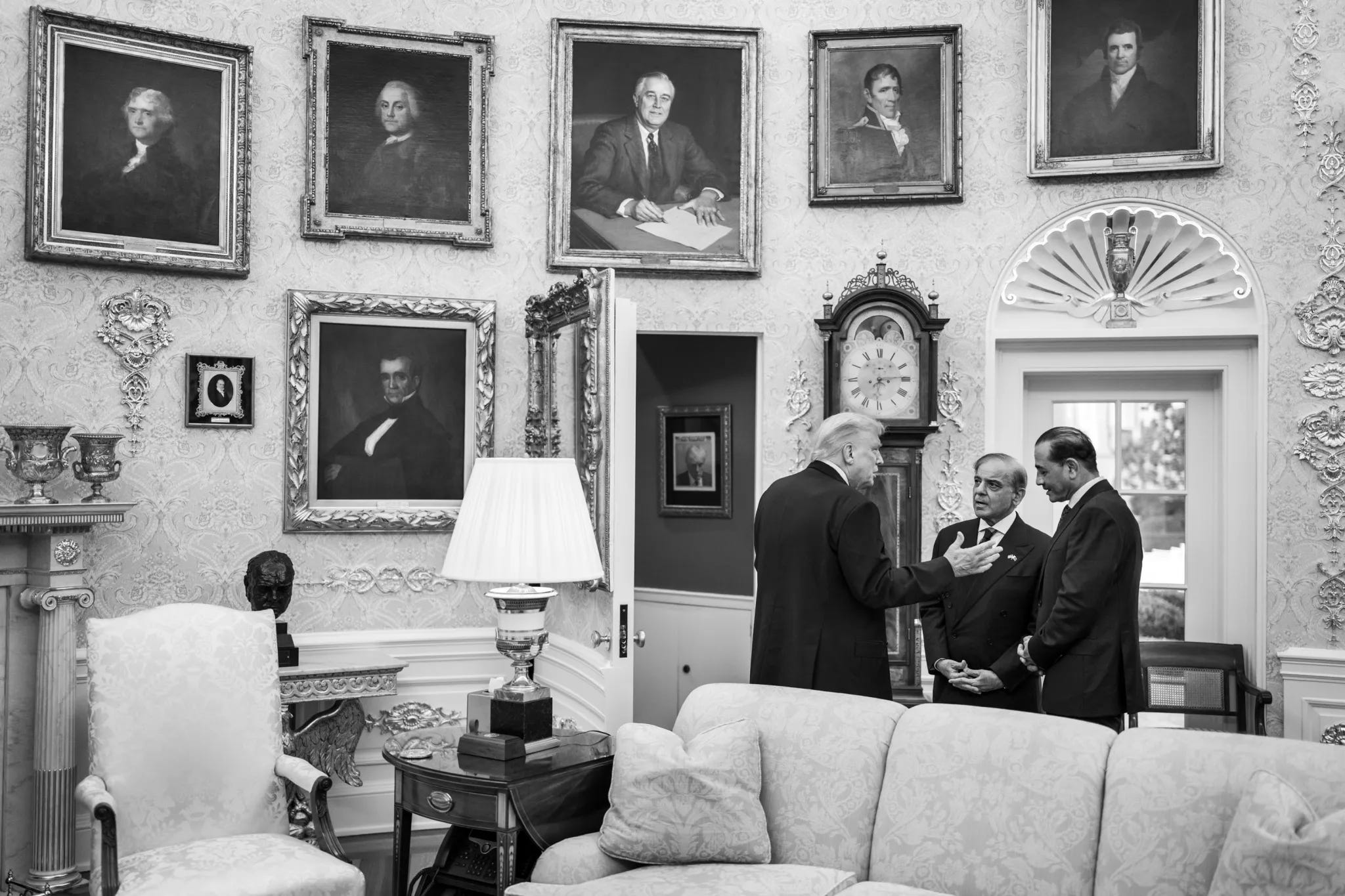
Pakistan military’s control expanded from domestic control to foreign policy decision-making. While the army has always exercised an outsized hand in the country’s international affairs, the degree of this authority is what warrants attention. Munir was invited to the White House in June 2025 for lunch with US President Donald Trump – the first time a US president had hosted a military chief from Pakistan who was not also the country’s head of state. It was an explicit, and formal acknowledgement by the US administration of where power in Pakistan actually resides.
The Trump-Munir relationship took a turn after Pakistan acknowledged Trump’s claims of brokering a ceasefire in the Indian subcontinent. What followed was more meetings, and a mineral deal between US and Pakistan. Pakistan enjoys enough trust in Washington to mediate talks between Iran and the US. This external validation of Pakistan, and Munir in particular could embolden the military. However, the longevity of US-Pakistan ties will remain to be seen beyond the current Trump administration.
One can’t deny Pakistan’s foreign policy gains in the last year, however this cannot paper over the cracks of the foundational fractures in the country’s economy and three-way security threat from the Tehreek-e-Taliban Pakistan (TTP), Baloch insurgency, and Islamic State Khorasan Province (ISKP). For the first time, Pakistan was ranked as the most terrorism-impacted country globally in the Global Terrorism Index 2026.
To look at Pakistan’s military history, every general who has concentrated power to this degree – Ayub, Yayha, Zia, and Musharraf- has ultimately encountered a legitimacy ceiling or pushback from within the establishment. The methods of extraction varied. While Operation Sindoor gave Munir the momentum he needed, the harder battle may lie within Pakistan itself.
 | A guest post by
|